

Oct 15, 2026
DiskDeleter
Law firms sit on some of the most sensitive data in existence — privileged client communications, case strategy, financial records, settlement details, and personally identifiable information that, if exposed, could end careers and trigger malpractice claims. Yet when it comes to retiring old laptops, decommissioning servers, or clearing devices after a case closes, many firms still rely on a simple "delete" or a factory reset — and that's a decision that can come back to haunt them.
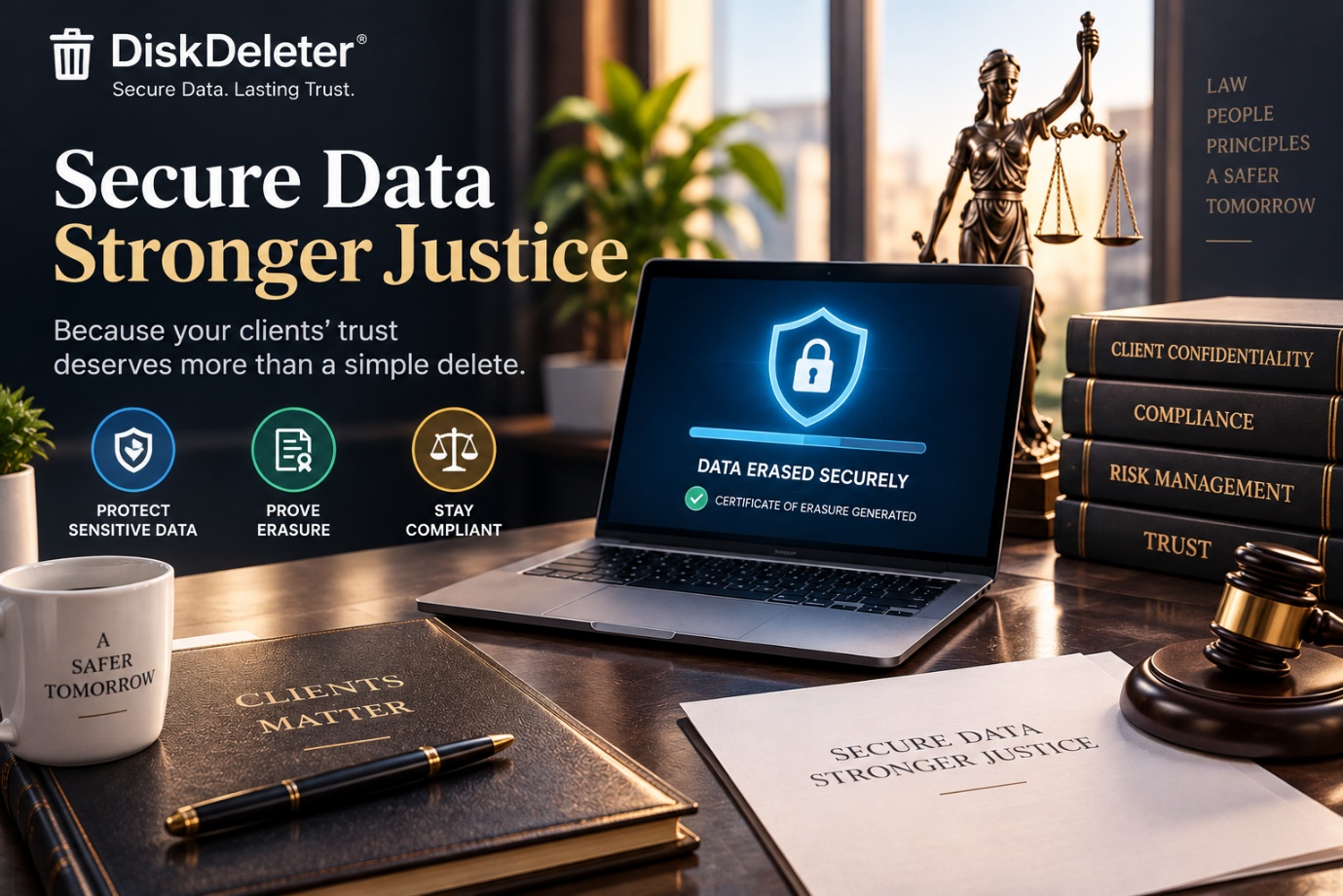
Choosing data erasing software for law firms isn't the same exercise as picking a generic IT tool. Legal teams operate under a different standard: not just "is the data gone," but "can we prove it's gone, to a court, an auditor, or an opposing counsel, years from now?"
Why Standard Deletion Fails the Legal Standard
Deleting a file or reformatting a drive doesn't erase data — it simply removes the pointer to it, leaving the underlying information recoverable with widely available forensic tools. For most consumers, that risk is theoretical. For a law firm, it's existential. A recovered file from a decommissioned laptop containing privileged attorney-client communication isn't just an embarrassment — it's a potential breach of confidentiality obligations and a direct liability exposure.
This is where secure data erasure for law firms becomes a compliance function, not just an IT task. The right data wiping software for legal firms doesn't just overwrite data beyond recovery — it produces proof that the process happened, when it happened, and to what standard.
The Compliance Backbone: NIST 800-88 and Defensible Documentation
Any law firm data sanitization software worth considering should align with NIST 800-88 — the widely recognized federal standard for media sanitization. This isn't a marketing checkbox; it's the benchmark auditors, regulators, and opposing counsel will look for if data handling is ever questioned.
Just as important as the erasure itself is what happens after: a proper Certificate of Erasure for every device, timestamped and detailed enough to hold up as audit-ready documentation. Combined with a documented chain of custody — showing exactly who handled a device, when, and what was done to it — this transforms data destruction from an invisible IT chore into a defensible legal record. If your erasure tool can't produce this paper trail automatically, it's creating more risk than it's solving.
Where This Actually Matters: Real Legal Use Cases
Data erasure isn't a once-a-year event for most firms — it's triggered by routine operations that happen constantly:
- Employee offboarding — associates and staff leave with laptops full of case data that must be sanitized before reassignment or disposal
- Laptop and desktop refresh cycles — outgoing hardware often gets resold, donated, or returned to a leasing company, all requiring provable secure disk deletion software
- eDiscovery decommissioning — once litigation concludes, review platforms and staging drives holding discovery data need certified destruction, not just deletion
- M&A data cleanup — when firms merge, acquire, or divest practice groups, legacy systems containing client data from the previous structure require careful sanitization
- Office relocation — old servers and workstations left behind during a move are a common, overlooked breach point
- End-of-lease hardware returns — leased equipment returned to a vendor without certified erasure is one of the most common (and preventable) sources of law firm data exposure
Each of these scenarios involves privileged information moving through hands that won't always exercise the same caution a lawyer would. A defined erasure policy, backed by the right software, closes that gap.
Law Firm Data Erasure Evaluation Checklist
Before selecting a data wiping tool for legal firms, confirm it can deliver on all of the following:
- ✅ Compliant with NIST 800-88 (Clear and Purge standards)
- ✅ Generates a tamper-evident Certificate of Erasure per device
- ✅ Supports full chain of custody logging and reporting
- ✅ Works across laptops, desktops, servers, and removable media
- ✅ Provides centralized reporting for IT and compliance teams to audit collectively
- ✅ Scales for both single-device offboarding and bulk hardware refresh projects
- ✅ Offers documentation formats acceptable for court, insurer, or regulatory review
If a solution can't check every box here, it's not built for the standard legal data handling actually requires.
Getting This Right, Without Getting It Complicated
The good news: this doesn't have to mean expensive enterprise software or a steep learning curve for your IT staff. DiskDeleter is built specifically around this compliance-first approach — NIST 800-88 aligned erasure, automatic Certificate of Erasure generation, and full chain-of-custody reporting, all through a straightforward interface designed for teams that need documentation as much as they need destruction. For law firms managing offboarding, refresh cycles, or eDiscovery wind-downs, it turns a routine IT task into an audit-ready, defensible process — exactly what the legal standard demands.
© 2026 Jungle KK - Powered By Knowledge Fortune