

Aug 11, 2026
DiskDeleter
Every Retired Device Could Be Your Next Security Incident
Cybersecurity budgets continue to grow, yet one of the biggest enterprise security risks often leaves the building unnoticed—retired storage devices.
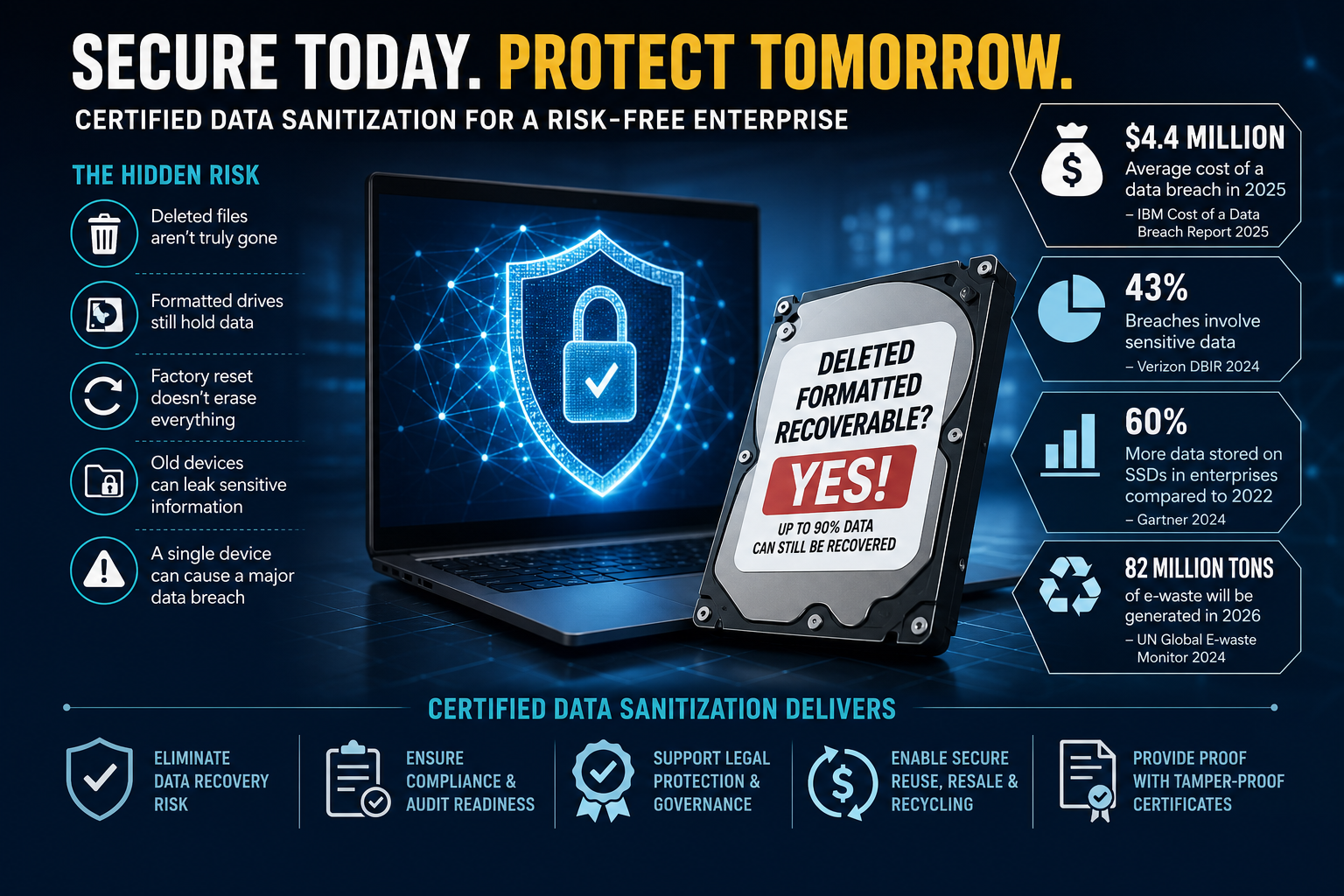
Organizations spend millions protecting live systems with firewalls, endpoint security, Zero Trust architecture, and AI-powered threat detection. But when laptops, servers, SSDs, HDDs, or storage arrays reach the end of their lifecycle, many businesses still rely on simple file deletion or formatting before disposal.
That assumption can be costly.
According to IBM's Cost of a Data Breach Report 2025, the global average cost of a data breach remains approximately $4.4 million, while many organizations still struggle with governance and data protection throughout the entire information lifecycle. (IBM)
The question for today's enterprises is no longer "How do we protect active data?"
It's "How do we ensure data never falls into the wrong hands after the device leaves our control?"
The Hidden Truth: Deleted Doesn't Mean Destroyed
One of the most common misconceptions in enterprise IT is believing that deleting files permanently removes data.
In reality:
- Deleting files only removes references to the data.
- Formatting a drive generally recreates the file system—not the data itself.
- Factory resets often leave recoverable information behind.
- Many deleted files can still be recovered using commercially available forensic software.
This hidden residual data may include:
- Customer databases
- Employee records
- Financial documents
- Intellectual property
- Legal contracts
- Login credentials
- Healthcare records
- Source code
- Emails and confidential communications
For cybercriminals, discarded storage devices can become an unexpected source of valuable information.
Risk Assessment Shouldn't End at Device Retirement
Modern organizations continuously evaluate:
- Cyber Risk
- Operational Risk
- Third-Party Risk
- Supply Chain Risk
- Financial Risk
- Compliance Risk
Yet surprisingly, end-of-life data risk is often overlooked.
Every storage device removed from service creates a new security decision.
Will it be:
- Reused?
- Returned after lease?
- Sent for repair?
- Resold?
- Recycled?
- Disposed of?
If sensitive information remains recoverable, that device becomes a potential security liability long after it leaves the organization's network.
True enterprise risk management doesn't end when hardware is powered off—it ends only when data is permanently destroyed.
Compliance Is No Longer About Good Intentions—It's About Proof
Global privacy regulations continue to raise expectations around how organizations handle sensitive information throughout its lifecycle.
Whether operating under GDPR, HIPAA, PCI DSS, ISO 27001, NIST 800-88, or other industry standards, businesses are increasingly expected to demonstrate—not simply claim—that confidential information has been securely erased.
Auditors, regulators, customers, and business partners want evidence such as:
- Verified erasure reports
- Device-specific logs
- Audit trails
- Tamper-proof certificates
- Documented sanitization records
Without verifiable proof, organizations may struggle to demonstrate compliance during audits or security assessments.
Why Certified Data Sanitization Has Become a Business Requirement
Certified data sanitization goes far beyond deleting files.
It permanently removes recoverable information using validated erasure techniques while creating documented evidence that the process was successfully completed.
For enterprises, this delivers measurable business value:
✔ Stronger Cybersecurity
Eliminates residual data before devices leave organizational control.
✔ Regulatory Compliance
Supports enterprise data protection policies and industry compliance requirements.
✔ Legal Protection
Provides verifiable documentation that sensitive information was securely destroyed.
✔ Safe IT Asset Reuse
Allows laptops, servers, SSDs, and storage systems to be securely redeployed across departments.
✔ Secure Resale & Recycling
Protects confidential business information while maximizing hardware value through safe resale or environmentally responsible recycling.
✔ Complete Audit Readiness
Generates documented proof for customers, regulators, and internal compliance teams.
Why Enterprise Automation Matters
Today's organizations manage hundreds—or even thousands—of storage devices across offices, data centers, and remote locations.
Manual erasure processes introduce:
- Human error
- Inconsistent procedures
- Missing documentation
- Longer processing times
- Increased operational costs
Enterprise-grade data sanitization software automates secure data erasure, verification, reporting, and certificate generation, ensuring every device follows a standardized, repeatable, and auditable process.
This not only strengthens security but also improves operational efficiency across the IT asset lifecycle.
From Security Policy to Security Action
The strongest cybersecurity strategies don't stop at preventing attacks—they eliminate unnecessary risks before they become incidents.
Organizations that integrate certified data sanitization into their IT Asset Disposition (ITAD) and cybersecurity policies gain far more than secure data destruction.
They gain:
- Better governance
- Reduced cyber risk
- Stronger compliance
- Faster audits
- Safer hardware lifecycle management
- Greater stakeholder confidence
In today's threat landscape, secure data erasure is no longer an optional IT task.
It has become an essential component of enterprise risk management.
Conclusion
Every organization eventually retires, replaces, repurposes, or disposes of storage devices. The real question is whether sensitive information leaves with them. As cyber threats, regulatory scrutiny, and enterprise governance requirements continue to evolve, certified data sanitization has become one of the smartest investments organizations can make. It transforms hidden security risks into documented compliance, protects valuable business information, and ensures every storage device reaches the end of its lifecycle without leaving behind recoverable data.
DiskDeleter empowers organizations to achieve this with confidence through 16 advanced data erasure processes, support for SSDs, HDDs, servers, RAID systems, tablets, and enterprise storage devices, tamper-proof deletion certificates, automated reporting, and compliance with globally recognized security standards. Whether you're strengthening cybersecurity, preparing for audits, or managing large-scale IT asset disposition, DiskDeleter delivers the certified, secure, and verifiable data sanitization enterprises can trust.
© 2026 Jungle KK - Powered By Knowledge Fortune