

Apr 15, 2026
DiskDeleter
In today’s digital economy, data is one of the most valuable assets an organization owns — and at the same time, one of its biggest liabilities if not handled properly.
Every decommissioned laptop, replaced SSD, or retired server carries a hidden risk: residual data.
In this two-part series, we will explore:
Part 1: The financial risks of improper data erasure
Part 2: The most cost-effective and secure solutions
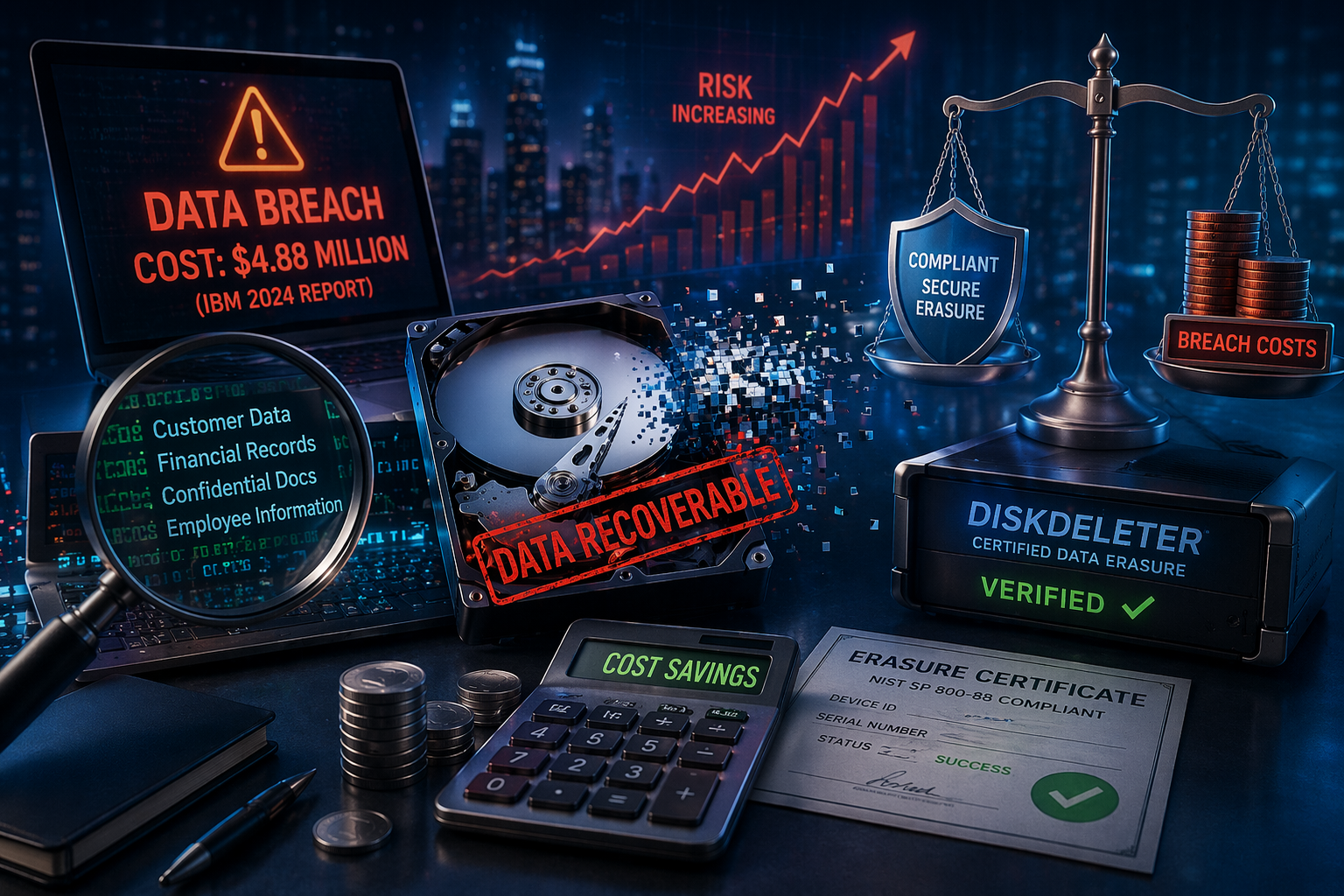
The Reality Behind “Deleted” Data
Many organizations still rely on formatting, factory resets, or manual deletion methods. However, these approaches do not permanently erase data.
Studies and forensic tests show that up to 60–70% of “wiped” devices using basic methods still contain recoverable data. With widely available recovery tools, sensitive information can be easily accessed.
This means business-critical data — customer records, financial information, internal communications — can unknowingly leave your organization.
The Financial Impact of Data Exposure
Improper data erasure is not merely a technical oversight—it is a direct financial risk.
According to IBM’s Cost of a Data Breach Report 2024, the global average cost of a data breach is $4.88 million. In sectors such as healthcare and finance, the cost can exceed $10 million per incident.
These losses are driven by multiple factors:
- Regulatory fines and compliance penalties
- Legal costs and customer compensation
- Incident response and forensic investigations
- Business downtime and recovery operations
- Long-term brand and reputation damage
In fact, studies suggest that over 30% of data breaches are linked to improperly disposed or decommissioned devices, not just cyberattacks.
Why Businesses Still Underestimate This Risk
Despite these numbers, many organizations still prioritize short-term savings over long-term protection.
A common assumption drives these decisions:
“Basic deletion is enough.”
But in reality, this creates a false sense of security.
For organizations handling hundreds or thousands of devices annually, even a 1% failure rate in data sanitization can expose significant volumes of sensitive data.
The Compounding Risk in Large Environments
Let’s consider a practical scenario:
- A company retires 2,000 devices per year
- Even if 5% are improperly erased, that’s 100 high-risk devices
Each of these devices could contain confidential data — making them potential entry points for data breaches.
The financial and reputational damage from even one such incident can far exceed the cost of proper data sanitization.
Conclusion
Improper data erasure is a silent risk that often goes unnoticed until it becomes a crisis.
As data volumes continue to grow, organizations must adopt structured, certified, and verifiable erasure processes to protect themselves from financial and compliance risks.
Solutions like DiskDeleter enable organizations to securely erase data with audit-ready verification, ensuring that sensitive information is permanently removed while maintaining compliance and operational efficiency.
Up next (Part 2):
The Economics of Data Erasure: Why the Right Strategy Saves More Than It Costs
© 2026 Jungle KK - Powered By Knowledge Fortune